


Want to Live Longer? Learn to Break Ageist Stereotypes
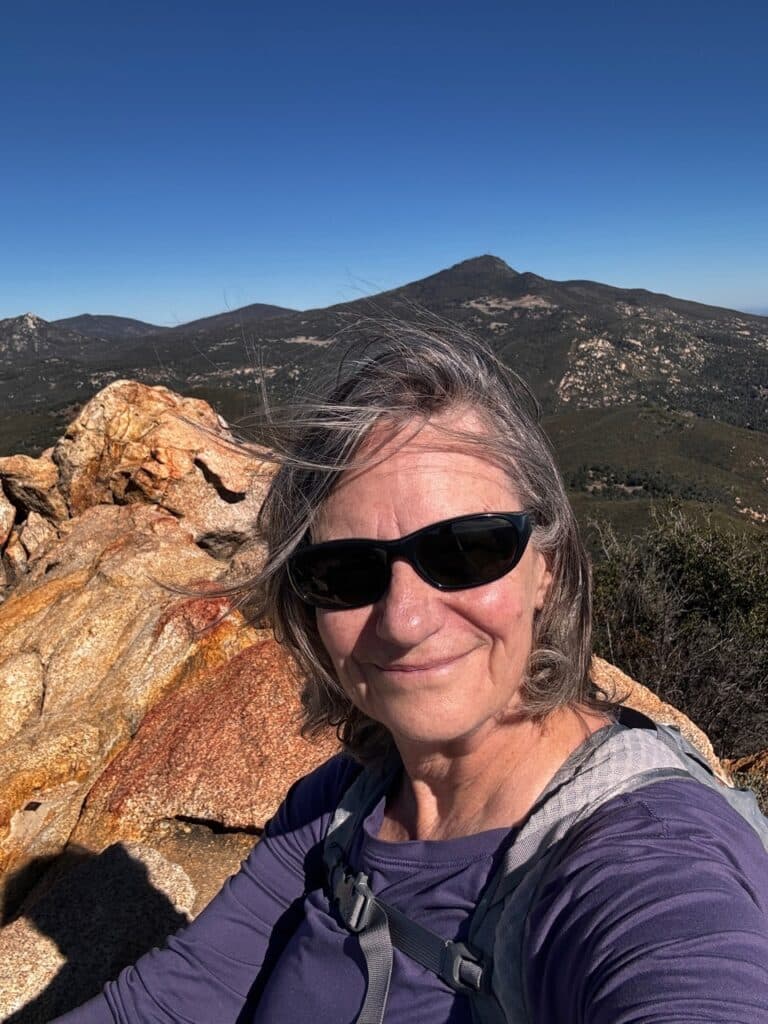
I love to walk. I’ve travelled to many beautiful places on foot. Whether climbing to the rocky summit of a mountain, standing at the base of a refreshing waterfall or just taking a stroll around the block, walking brings me sanity and joy. It’s a non-negotiable part of my daily movement practice.
So when we checked into our southern California campground a few weeks ago, I inquired about local hikes. The ranger, a woman who looked to be about my age, handed me a copy of a hand-drawn map of trails through the oaks and chaparral in the hills above the campground. She pointed out the location of historic grinding rocks used by people of the Kumeyaay nation to process acorns.
And then, with a withering look, she cautioned, “But, all these trails are very up and down.” I felt myself bristling at her assumption that I might not be fit for such adventure. I said, perhaps a bit too forcefully, “That’s exactly what I’m looking for!”

What I wanted to shout was, “You obviously don’t know who I am!” I felt defensive and unseen. The tone of the ranger’s warning cut deep into my sense of myself as a strong, capable person.
Read more: Honoring Our Bodies of Experience, Fulfilling Our Dreams of Adventure.
Invisible Ageism
Ageist stereotypes are so ingrained in our culture that we often don’t even notice them, at least not consciously. Perhaps you’ve experienced microaggressions like these:
- The bank teller calls you “sweetie.”
- You can’t find a birthday card for a friend of a certain age that isn’t a degrading joke about growing old.
- A health provider speaks to you as though you were less than a full-grown adult.
- You feel an ache or pain and automatically think, “Well, that’s just the price of getting old.”
These “everyday verbal, nonverbal, and environmental slights, snubs, or insults, whether intentional or unintentional, communicate hostile, derogatory, or negative messages” to people because of their age.
What Is Ageism?
Ageism, like all -isms, causes real damage. “Attitudes about age – as well as race and gender – start to form in early childhood,” writes Ashton Applewhite, author of the ground-breaking manifesto, This Chair Rocks.
Applewhite says, “Over a lifetime [these attitudes] harden into a set of truths: ‘just the way it is.’ Unless we challenge ageist stereotypes – Old people are incompetent. Wrinkles are ugly. It’s sad to be old – we feel shame and embarrassment instead of taking pride in the accomplishment of aging. That’s internalized ageism.”
Applewhite explains that ageism makes growing older much harder than it has to be by preying on our fears and negating the benefits of aging. “It damages our sense of self, segregates us, diminishes our prospects, and actually shortens lives.”
Ageism Causes Real Damage
Being exposed to just a few minutes of negative stereotypes about aging, says Yale professor and social psychologist Becca Levy, can decrease physical and cognitive abilities. Dr. Levy is one of the leading experts on the psychology of successful aging and author of the award-winning book, Breaking the Age Code: How Your Beliefs About Aging Determine How Long and Well You Live.
She’s demonstrated through her research that many health problems formerly considered to be entirely due to the aging process, such as memory loss, hearing decline, and cardiovascular events, are instead influenced by the negative age beliefs that dominate in the US and other ageist countries. Levy offers surprising evidence that one of the best ways to live a long and healthy life is to rethink our own ingrained stereotypes about what it means to be an older person.
And before you dismiss this idea as a way to just paste a fake smile on the process of aging, take a moment to explore your own beliefs about aging. Here is a link to Dr. Levy’s quiz about images of aging. It asks you to think about a short list of words (healthy, senile, capable, helpless, active, grumpy, wise) and how they match with the images or pictures that you have in your mind of older people. What you really think just might surprise you!
Read more: 4 Qualities That Help You to Embrace Aging.
Let’s Talk About Ageism
Both Becca Levy and Ashton Applewhite believe that awareness is the first step to undoing ageism. This is how we begin to understand thatpersonal problems, such as the microaggressions listed above, are actually widely shared social problems that require collective action.
What Internalized Ageism Sounds Like in Your Head
Sometimes the most damaging ageist messages aren’t coming from other people – they’re coming from inside our own heads. These thoughts are often so automatic, we don’t even question them. That’s internalized ageism: when the negative cultural messages about aging become part of how we see ourselves.
Here are a few examples of what internalized ageism can sound like:
- “I shouldn’t wear that at my age.”
- “It’s too late to start something new.”
- “I must be slowing down because I’m old.”
- “No one wants to hire someone my age.”
- “I’m just not as sharp as I used to be.”
- “I need to fade into the background now.”
- “You can’t teach an old dog new tricks.”
- “I’m too old to date, travel, or take risks.”
These beliefs often show up in subtle ways – in the clothes we don’t wear, the classes we don’t sign up for, the silence we keep in conversations, or the way we dismiss our own dreams before anyone else can.
How to Spot These Thoughts
Start by noticing when you use age to explain or excuse something:
- “I’m not going to that event…I’m probably too old for that crowd.”
- “I’m not good with tech…I didn’t grow up with it.”
- “I don’t want to be the oldest person in the room.”
Pay attention to words like too late, too old, shouldn’t, or can’t – they’re often red flags that you’re limiting yourself based on stereotypes, not reality.
How to Challenge Them
Once you spot these thoughts, try replacing them with questions or statements that open up possibility instead of shutting it down:
- Instead of: “I shouldn’t wear that.”
Try: “Do I like how I feel in it?” - Instead of: “It’s too late to start something new.”
Try: “If not now, when?” - Instead of: “I’m slowing down because I’m old.”
Try: “What does my body need today, and how can I support it?” - Instead of: “I’m not good with technology.”
Try: “I can learn – plenty of people my age have.”
These aren’t just affirmations; they’re ways of reclaiming your experience and separating what’s truly yours from what society has told you to believe.
The truth is, age is not the enemy. The real obstacle is the narrow script we’ve been handed about what aging should look like. When we start rewriting that script – in our thoughts, our choices, and our voices – we create space for a more expansive, joyful, and empowered version of growing older.
The Benefits of Dismantling Ageism
Ageism isn’t just offensive – it’s harmful to your health. Research shows that internalizing negative beliefs about aging can have serious consequences on both mental and physical well-being. The good news? Changing your mindset about aging doesn’t just feel better – it works better. Studies led by experts like Dr. Becca Levy at Yale University show that cultivating more positive beliefs about aging can actually improve how your body and brain function as you get older.
Stronger Memory and Cognitive Health
Dr. Levy’s research found that people with positive views of aging performed significantly better on memory and attention tasks than those with negative beliefs. In fact, a positive self-perception of aging was associated with better cognitive performance over time – even when other risk factors were accounted for. Simply put, if you believe aging includes growth, learning, and adaptability, your brain is more likely to keep showing up for you.
Improved Physical Strength and Balance
People with optimistic views about aging tend to stay more physically active, maintain better balance, and experience fewer falls. Why? When you don’t assume weakness or frailty is inevitable, you’re more likely to keep moving, try new activities, and stay engaged in your body’s needs. Positive beliefs also influence the body’s stress response in a way that protects muscle strength and mobility.
Faster Recovery from Illness or Injury
Studies have shown that older adults who hold positive views about aging recover more quickly from illness, including heart attacks and surgeries. They are more likely to follow through with rehabilitation, advocate for their care, and maintain a hopeful attitude – factors that contribute to better medical outcomes.
Longer Life Expectancy
This one is especially eye-opening: In a landmark study, Dr. Levy found that people with a positive attitude about aging lived an average of 7.5 years longer than those with negative views. That’s a bigger boost than many lifestyle factors, including exercise and low cholesterol. The belief that life continues to have meaning and value in later years can literally add years to your life.
These findings remind us that aging well isn’t just about what’s happening in our bodies—it’s also about what’s happening in our minds. When we push back against stereotypes and reclaim aging as a time of strength, growth, and possibility, we don’t just feel better – we live longer and live better.
Meanwhile, back at the campground, I have easily climbed up to the grinding rocks many times and stood admiring the expansive westerly views and more than a few glowing sunsets. From this lofty place, I’m able to reflect on the good life I’m living in my early retirement years. Let’s bust up those old, tired stereotypes and support each other to walk new pathways towards aging well.
Read more AGEISM – ARE OLD WOMEN THEIR OWN WORST ENEMIES?
Editor’s Note: Article updated by Sixty and Me.
Let’s Have a Conversation:
Have you felt the physical, mental or emotional impact of ageist microaggressions? Are you able to recognize ageism in the moment or only after the fact? How have you been able to respond to ageism when you encounter it in society and in your own life?
Tags Getting Older


Totally agree. At 66, I am in better shape than ever, having free access to great gym (thanks Medicare) and have taken up spinning, aquafit, run/walking, and daily yoga. Have embraced this fit, healthy and older body.
If someone talks down to us, loudly, because we are older (& therefore stupid), interrupt them, even more loudly & say “There’s no need to yell, I’m not deaf”!
Or, gently say your truth. So much anger here…..
I like to ask myself, “What’s the motive behind the comment?” Is the person just trying to be helpful and kind to me, or are they trying to be derogatory? 9.9 times out of 10, people are just trying to be kind. Being kind back is what makes the world a better place. If we are irritated when people are just trying to be kind to us and take their efforts as agism, perhaps we really are the stereotypical grumpy people that others categorize. Let’s show the world that we are loving, kind, and compassionate even as we grow older, and not take every “agism” comment to be offensive. Instead, we should see the heart and motive of individuals and return the beauty of their words with kindness. If we feel the need to correct them, then let that also be done in love.
Amen, Michelle. We seem to be on the same page. Gentle, kind responses fill the world with more love. I found my soul sister in you.
100% agree.
And while we’re about it, let’s get rid of that made up grievance word “microaggressions’ that encourages taking offense at every little thing …..
I will turn 75 in January. Have had some health issues but I’m doing pretty well now. I totally agree with the article! Going forward I plan to be more mindful of ageism!! Thanks!
Yes, “sweetie”, “honey”! It really irked my husband some years back when in his 60’s a waitress referred to him as “young man”. As for me, when a nurse asked “How young are we?” I answered in a baby voice, “Fiiiive. How about you?” Wouldn’t it be more appropriate to ask anyone of any age, “What’s your birthdate?” or just look on the chart.
I want to be clear that this response was not by me, Patricia Lucas.