


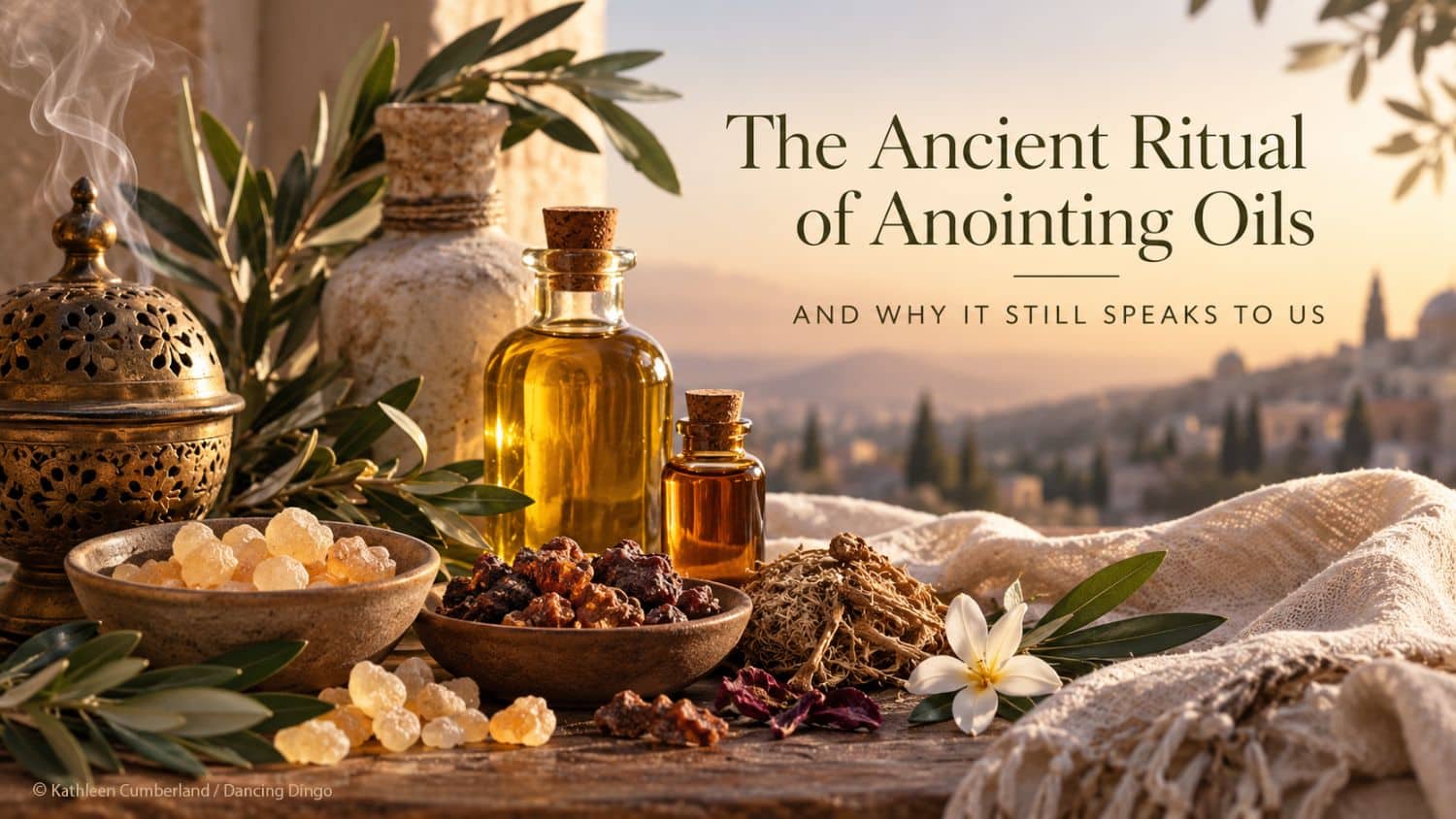
The Ancient Ritual of Anointing Oils – and Why It Still Speaks to Us
Some rituals survive because we are told to preserve them. Others survive because, thousands of years later, they still make sense.
A little oil in the palm. A familiar scent. A moment set apart from the rest of the day.
Long before “self-care” became a phrase, people were using fragrant oils to mark moments of prayer, hospitality, mourning, celebration and ordinary daily care.
I became interested in anointing oils because I work with botanical fragrance. I knew frankincense and myrrh as aromatic materials, of course, but the more I read about them, the more fascinated I became by the lives they had lived before they ever reached a modern perfume bottle.
When Fragrance Was Precious
It is difficult for us to imagine a world in which scents had to travel hundreds or even thousands of miles to reach us.
Frankincense and myrrh began as resins gathered from trees. Spikenard, or nard, was another highly prized aromatic. Labdanum, another ancient aromatic, is a sticky resin associated with rockrose shrubs of the Mediterranean.
These weren’t simply pleasant smells. They were valuable materials carried along ancient trade routes and used in religious observance, perfume, traditional remedies and daily life.
And then there was olive oil.
Today we may think first of the bottle beside the stove, but for ancient people olive oil was remarkably versatile. It provided food and light. It was used on skin and hair. It was offered as a gesture of hospitality and became part of sacred ceremony.
Often, it was the carrier for something more precious: fragrance.
There is something about that combination that I find beautiful. Something ordinary and useful became the foundation for something extraordinary.
Frankincense, Myrrh and Stories We Still Know
Even people who know very little about ancient botanicals usually recognize two names: frankincense and myrrh.
For many of us, they first appeared in a Christmas story. The Magi brought gold, frankincense and myrrh to the infant Jesus, gifts that can sound wonderfully exotic when you’re a child and don’t yet know what two of them actually are.
I don’t remember anyone stopping the Christmas story to explain the botany.
Perhaps that would have ruined the moment.
But discovering them as an adult makes the story richer. They were not imaginary treasures. They were real aromatic substances, valuable enough to travel great distances and important enough to become associated with worship, ceremony and honor.
Myrrh appears again in another part of the biblical story, associated with Jesus’s burial. Spikenard, or nard, appears in an especially intimate account: Mary anoints Jesus with the costly perfume, filling the house with its fragrance. John 12:3
Whatever one’s religious beliefs, these are remarkably human scenes.
People used scent to honor. To welcome. To grieve. To remember.
Thousands of years later, we still do.
Maybe Ritual Doesn’t Have to Be Grand
I think the word ritual can make something sound formal.
But our lives are full of tiny rituals we hardly notice.
The cup of coffee we make the same way each morning. Lighting a candle when evening comes. Putting on a favorite fragrance before going out. Sitting quietly for a few minutes before everyone else wakes up.
The object itself isn’t necessarily important.
The attention is.
A small ritual says: This moment is different from the one before it.
That realization changed the way I thought about anointing oils. I stopped seeing them simply as artifacts of ancient religious practice and began seeing the remarkably simple idea underneath them.
Oil. Fragrance. Intention.
Nothing complicated is required.
A drop touched to the skin before prayer. A little oil in the palms during meditation. A familiar aroma while journaling. A quiet moment of remembrance.
For someone else, it may simply be a way to stop moving for a moment.
Old Things in Modern Hands
Eventually, my curiosity followed me into my own studio at Dancing Dingo. I began working with olive oil and some of the botanicals I had been reading about, frankincense, myrrh, spikenard and labdanum.
There was something unexpectedly moving about opening the bottles.
These were materials with histories far longer than mine. People had valued their scents when our modern world would have been unimaginable to them.
Yet the experience itself hadn’t become obsolete.
You open a bottle.
You breathe in.
For just a moment, you pay attention.
Perhaps that is why these ancient botanicals still feel at home in modern hands. The world around them has changed almost beyond recognition.
The human need to stop for a moment, to remember what matters, and to make an ordinary moment meaningful has not.
For readers interested in exploring the history of these aromatics further, I’ve written more about Remarkable Botanicals: Stories That Have Spanned Centuries, as well as the Botanical Anointing Oil Collection they eventually inspired.
Let’s Have a Conversation:
Which botanical oils have you read about? What rituals do you connect them to? Do you have your own ritual connected to fragrance?
Tags Mature Skin Care


I use eo’s everyday for healing. They work great.
Thank you, Rhonda. It sounds as though essential oils have become a meaningful part of your daily routine. I love hearing how these beautiful botanicals find their way into our everyday rituals.
Yes I love essential oils and wear them everyday
Me, too.
Thank you, Jane! I love that you wear them every day. There is something so personal about choosing a scent and making it part of your daily ritual.