


Grandma Emoji Needs a Makeover!

I was on my iPhone, giddily texting my friends that I’d become a grandmother, when I came face to face with Grandma Emoji. What the ^@#$%&*?! This is what Apple thinks we look like? The Old Maid?
To make matters worse, Grandpa Emoji looks years younger. Pairing them makes Grandma Emoji seem like an 80-something mother with her 60-something son, or worse – like a cougar. We need to take a bite out of Apple and get them to give Grandma Emoji a makeover.
With her granny glasses, lumpy gray bun and dazed expression, Grandma Emoji defies not just modern fashions, but our scientifically proven superpowers. Groundbreaking research shows that far from being confused, grandmothers are neural superheroes.
Our Brains Look Amazing for Their Age
In one of three recent Emory University studies on grandmothers, researchers compared the actual and biological ages of grandmothers’ brains and non-grandmothers’ brains. Using specialized scans and an algorithm called Brain Age Gap Estimation, they discovered this stunning fact:
The grandmothers’ brains were 5.5 years younger than the non-grandmothers’ brains.
Part-time grandmothering, the researchers concluded, appears to “actually slow the aging process.”
Over time, our brain’s gray matter and white matter contract, while fluid-filled spaces called ventricles expand. A brain that has changed less than average is biologically younger than its actual age.
The grandmothers’ brains showed much less change than the non-grandmothers’ brains did. In fact, grandmothers who spent more time with their grandchildren had even younger brains than grandmothers who spent less time, and the more positive the time together felt to them, the more it slowed their aging.
Even as our hair grays and whitens, the power of grandmothering guards our gray and white matter. Exhausting as young grandchildren can be in the short term, time with them is so cognitively enriching that it keeps not just our hearts young, but our minds.
Grandmothering Gives Our Brains a Love-Lift
A second study found another superheroic difference in grandmothers’ brains. Grandmothers have more receptors for oxytocin.
Many of us cringe at the word “oxytocin,” associating it with childbirth. The IV oxytocin I got during labor with my younger son didn’t kick in until after his birth – something I like to remind him of every Mother’s Day.
But oxytocin, called “the love hormone,” is also key to connection. Our bodies release oxytocin when we fall in love, and for our grandchildren we fall hard. That love inspires our brains to add oxytocin pathways, deepening our love and flooding us with a sense of well-being. For doing what already feels good, we’re rewarded with a feel-good loop. Our love brings greater love; greater love brings greater joy; greater joy brings greater love; and repeat. It’s more than a feeling: grandmothers are physiologically customized for caring.
The Name’s Bond, . . . Emotionally Empathic Bond
Until recently, we’ve struggled to name and explain the extraordinary tie between grandmother and grandchild. Ten years ago, journalist Lesley Stahl wrote in Becoming Grandma, “[T]here is something beyond the chemistry of oxytocin that binds us to these little fellas. It seems embedded deep in our genes.” Three years later, author Anna Quindlen wrote in Nanaville that since grandmothers have already raised children, when it comes to grandchildren “it’s a little challenging to suss out why exactly it can be so magical.”
Scientists now know why – they’ve learned the magic is embedded deep in our genes and performed in our brains.
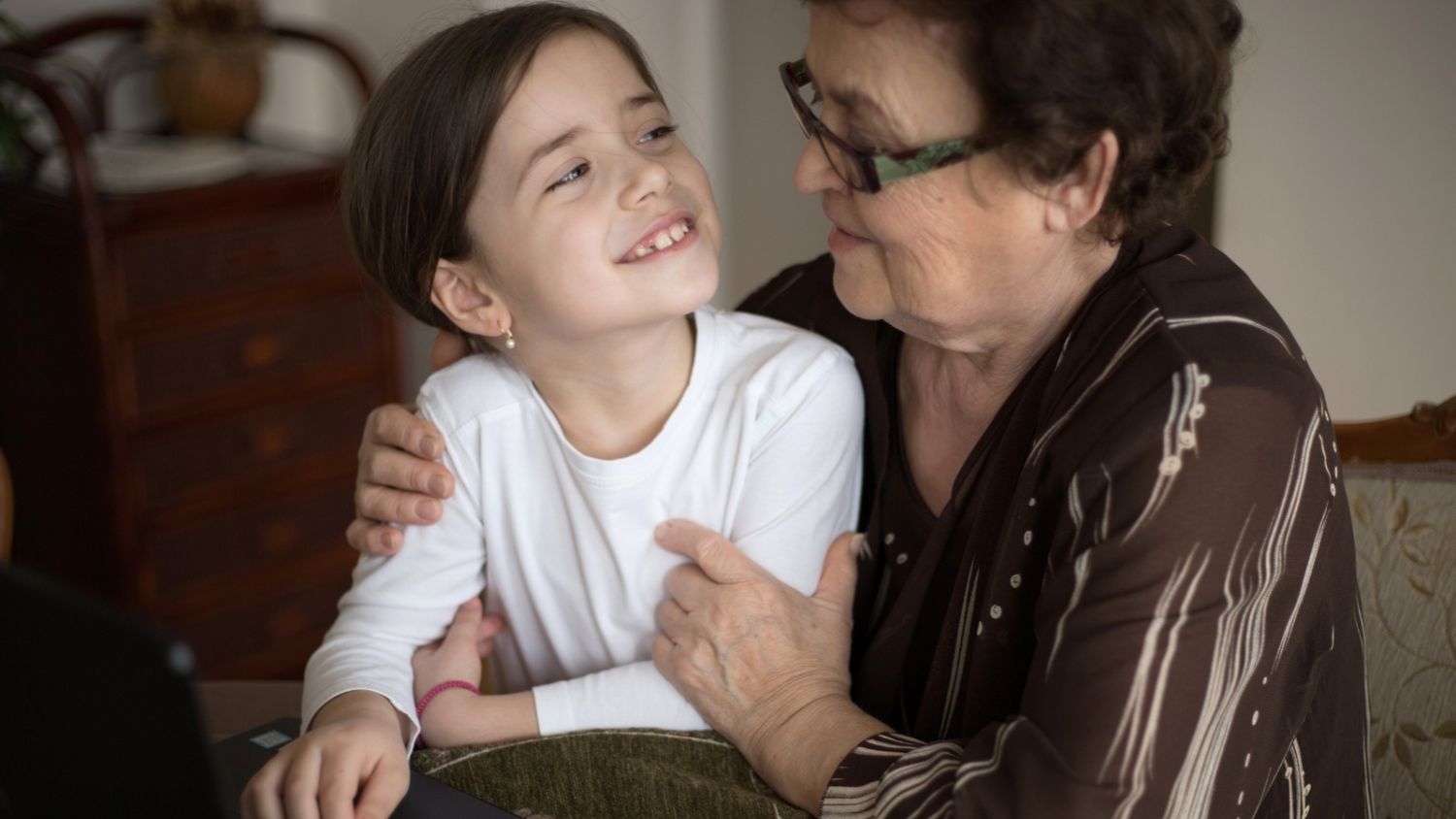
Our most dazzling trick might be the one a third study revealed: an ironclad bond of emotional empathy. Imaging showed that grandmothers’ brains lit up in emotional empathy when the grandmothers saw photos of their grandchildren, but only in cognitive empathy when they saw photos of their children. This means that while grandmothers want to understand their children’s feelings, they actually feel their grandchildren’s feelings.
“If their grandchild is smiling, they’re feeling the child’s joy,” the lead scientist said. “And if their grandchild is crying, they’re feeling the child’s pain and distress.”
As the millennials say, we feel all the feels.
Even more dazzling are the superheroic results our superheroic bond brings. Research across disciplines has found that involved grandmothers and their grandchildren tend to live longer, enjoy greater health, experience more happiness, and have sharper minds.
A Vote for You
According to Baylor University, every day more than 90% of people communicating online use emojis, meaning every day people are literally sending the message that grandmothers are addled and antiquated. Until 2016, Apple didn’t even feature female emojis who worked; the closest were a bride and a male surfer with long hair. A campaign arose urging Apple to add workingwoman emojis. They did.
Now it’s our turn.
I’ve started a “Ban the Bun” campaign to get the word out about our superpowers and to scrub the Old Maid stereotype. I’d love for you to join – simply by voting.
The campaign is for all women 60-plus, all over the world. Poor Grandma Emoji is iPhone’s emoji not only for “grandmother,” but also for “older woman.”
Let’s get Apple to ditch those specs, the daze, that bun. Grandmothers, and all older women, are supremely strong, vibrant, accomplished, keen and vital in every way. Until Apple shows us as the superheroes we are, we can use this emoji instead:
Let’s Have a Conversation:
What has surprised you most about how becoming a grandmother changed you? Where do you notice your influence most clearly in your grandchild’s life? Has becoming a grandmother changed the way you think about aging? How?
Tags Brain Health


