What Does the Food on Your Plate Tell You About Life in a New Country?
I have always felt that comedians make some of the best travel presenters. Almost 10 years ago, the BBC dispatched comedians Dara Ó Briain and Ed Byrne to Southeast Asia for a three-part series called Dara & Ed’s Road to Mandalay.
Their first stop was Malaysia, which, for those unfamiliar with the country, is a remarkable melting pot of cultures, not just from across Asia but from around the world. And perhaps nowhere is that mix more obvious than in its food.
Towards the end of their Malaysian adventure, Dara made an observation that has stuck with me ever since.
“If you want to see all of Asia, come to Malaysia,” he remarked, comparing the country to a buffet of different cultures, something you could see reflected on the plate.
And then came the punchline, as they prepared to head for Thailand: “Of course now we’re going to Thailand, and they just have Thai food.”
It was, of course, a joke at Thailand’s expense. But beneath the humour was a rather perceptive observation. Food isn’t simply something we eat. It tells us about a country’s history, the people who settled there, the cultures they brought with them and how those influences have evolved over generations.
Malaysia provides a particularly fascinating example of this. And if you want to see centuries of trade, migration and cultural exchange reflected in the food, there are few better places to start than Penang.
Penangites Take Their Food Seriously – Very Seriously
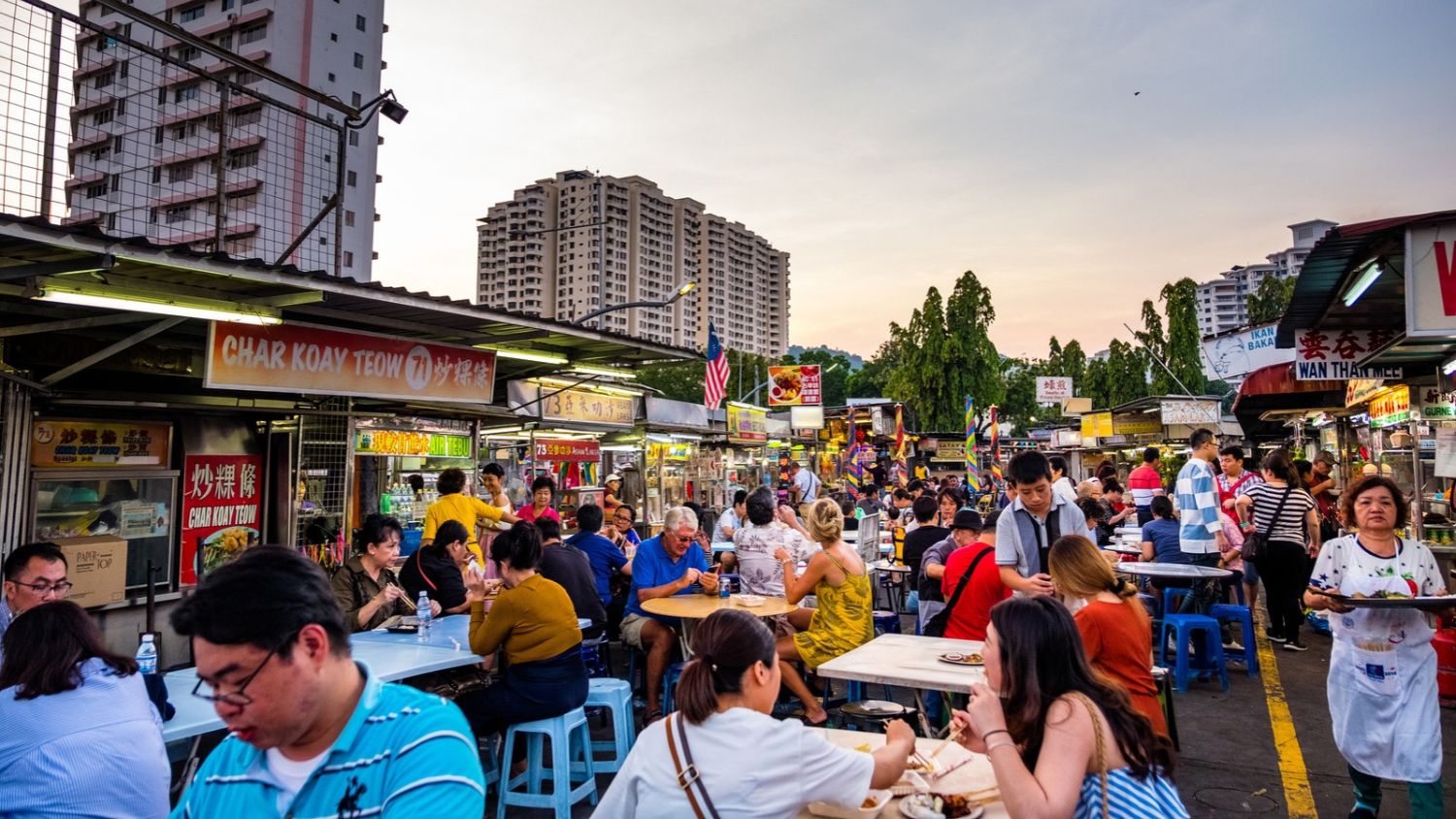
As with much of Malaysia, everyday eating revolves around hawker centres and traditional coffee shops, known as kopitiams. Long queues form at the most popular stalls, with people perfectly prepared to wait for whatever speciality that particular hawker is famous for.
And this is something I’ve always found fascinating. In a Western restaurant, we’d generally expect a reasonably broad menu. At a Malaysian hawker stall, it’s often quite the opposite. One person, or perhaps a family, might have spent decades, sometimes across several generations, perfecting just a handful of dishes.
It might be char kway teow, a plate of wok-fried flat rice noodles, or Penang’s famous laksa, a spicy, sour fish and tamarind noodle soup. There are plenty of other stalls selling something similar, but everyone seems to have an opinion about which one does it best. Hence the queues.
The beauty of a hawker centre is that while each stall might specialise in just a few dishes, collectively they offer an extraordinary variety of food, with something for even the fussiest of eaters.
But hawker centres aren’t just about the food. They’re social spaces too, and one of the things I particularly like is how comfortably they accommodate different ways of eating.
Whether you’re a couple or on your own, you can find a table, enjoy your meal and simply watch the world go by. Or, if you’re feeling sociable, you might share one of the larger tables and strike up a conversation with the people around you, perhaps starting by asking what they’re eating.
For someone settling into a new country, particularly later in life, these informal opportunities for social interaction can be rather valuable. You don’t necessarily need to join a club or organise a gathering. You can simply turn up, have something to eat and see where the conversation takes you.
And in Penang, the food itself tells a story stretching back centuries.
A Little History Served on a Plate
Trade had been passing through the Strait of Malacca for centuries before the British established George Town as a free port in 1786. The new administration attracted merchants and settlers from China, India, the Malay Archipelago and further afield.
They brought their languages, religions, customs and, inevitably, their food.
Chinese communities brought cooking techniques and dishes that evolved to incorporate local ingredients. Indian traders and settlers introduced their own culinary traditions, while Malay cooking was already deeply rooted in the region.
Over time, these influences didn’t simply remain separate. They adapted, borrowed and occasionally blended into something quite different from what you might find in their countries of origin.
This is, after all, a country that celebrates several different new years, each bringing its own traditions and, naturally, its own food to the table.
Take char kway teow, for example. Its roots lie in Chinese cooking, but the Penang version has developed a character all of its own.
Then there’s nasi kandar, closely associated with Penang’s Indian Muslim community. Rice served with a selection of curries and side dishes, it reflects another chapter in the island’s history.
Perhaps the most fascinating example is Peranakan, or Nyonya, cuisine. Developed through generations of cultural exchange, particularly between Chinese and Malay traditions, it combines ingredients, spices and cooking techniques in ways that are distinctly local.
More Than Just Something to Eat
What interests me almost as much as the food itself is the role it plays in Malaysian society.
Eating out isn’t necessarily reserved for special occasions. For many Malaysians, it’s part of everyday life. Breakfast before work, lunch with colleagues, an evening meal with family or simply meeting friends for a drink and something to eat.
You might start the morning with nasi lemak, rice cooked in coconut milk and traditionally served with sambal, anchovies and peanuts. Or perhaps roti canai, an Indian-influenced flatbread accompanied by curry, washed down with a glass of teh tarik, Malaysia’s famous tea made with condensed milk.
These dishes are enjoyed across communities, and in 2024 UNESCO added Malaysia’s breakfast culture to its list of Intangible Cultural Heritage of Humanity, recognising not simply the dishes themselves but the social traditions surrounding them.
Of course, Malaysia’s cultural diversity doesn’t mean everybody eats everything. Religious practices, dietary restrictions and family traditions still influence what people eat and where they eat it.
But that’s rather the point. Food can reveal both what communities share and what makes them distinct.
And it’s not always necessary to speak the same language to find common ground over a good meal.
From Being a Visitor to Becoming a Regular
So what does all this have to do with retiring abroad?
Quite a lot, I would suggest.
When we visit somewhere on holiday, food is often part of the adventure. We seek out famous restaurants, sample local specialities and perhaps come home with a few favourite dishes.
But when you move somewhere permanently, food takes on a different role.
You’re no longer simply sampling the local cuisine. You’re becoming part of the everyday routines that surround it.
You discover your favourite place for breakfast, the stall that makes its noodles exactly how you like them, or the little coffee shop where you gradually become a familiar face. For someone starting a new chapter later in life, those small moments of familiarity can make a real difference.
Food can also be one of the easiest ways to engage with a new culture or, in Malaysia’s case, cultures. You begin to recognise ingredients, understand local customs and perhaps learn a few words of one of the many languages simply through ordering your lunch, although English is widely spoken if you get stuck.
Of course, not everyone will embrace unfamiliar food with equal enthusiasm. Some people have dietary restrictions, others dislike spicy food, and there will always be occasions when nothing quite satisfies like something familiar from home.
But I do think food deserves more consideration when we’re assessing whether a country might suit us in retirement.
After all, you’re going to be eating there every day.
What Does Your Plate Tell You?
Malaysia is just one example, albeit an especially colourful one.
Every country has a culinary history shaped by geography, migration, trade, religion and changing tastes. Sometimes those influences are obvious. Sometimes they’re hidden in a dish whose origins even the locals might disagree about.
The next time you visit somewhere you’re considering for retirement, perhaps look beyond the restaurant recommendations and tourist favourites.
Visit a local market. Try a neighbourhood coffee shop. Watch how people interact and imagine yourself becoming part of that everyday scene. Would you feel comfortable eating there on your own? Could you see yourself becoming a regular?
You might discover rather more about the country, and whether you’d enjoy living there, than you expected.
Let’s Chat:
Have you ever visited or lived somewhere where the local food helped you feel part of the community? Or have you found yourself missing the familiar food and eating traditions of home?
Tags Living Abroad