


Meeting Life Transitions After 60: Navigating Our Losses Without Getting Lost
By the time we reach our 60s and beyond, we’ve lived many lifetimes within one life.
We’ve loved, built careers, raised families, created identities and, inevitably, we’ve also experienced loss. Some losses are visible: the death of a loved one, the end of a marriage, a career shift. Others are quieter but just as profound: children leaving home, changes in our bodies, shifting roles, or the realization that life is entering a new chapter.
These transitions can leave us asking a question many women don’t say out loud:
Why do I feel so stuck, even when I know I should be moving forward?
Loss Doesn’t Just Live in the Mind
One of the most overlooked truths about navigating life transitions is this: loss is not just emotional; it’s physical. It lives in the body.
You may feel it as tightness in your chest, heaviness in your shoulders, a lump in your throat, or a constant sense of fatigue. You might notice restlessness, anxiety, or the opposite, a kind of numbness that makes it hard to feel anything at all.
This isn’t something you’re doing wrong. It’s how the body processes overwhelming experiences. And yet, many of us try to “think” our way through transitions, analyzing, pushing forward, or telling ourselves to just move on.
But the body doesn’t move on that way.
The Pressure to Move Forward
Women over 60 are often expected to carry transitions with quiet resilience. You may hear messages like:
- “This is just part of life.”
- “Be grateful for what you have.”
- “Stay positive.”
While well-meaning, these messages can create pressure to bypass what you’re actually feeling.
The truth is, moving forward doesn’t mean leaving everything behind. It means learning how to carry your experiences differently, so they don’t weigh you down.
A Different Approach: Living With Loss
What if, instead of trying to get over life’s transitions, you learned how to live with them?
This is where a body-based approach can be transformative. Ignoring or hiding our painful thoughts only increases their hold on us and manifests in physical ailments. As Pema Chodren, a renown Buddhist nun says, “What we resists persists.” Our thoughts are closely aligned with, and are boldly evident, in our bodies. Good thoughts, healthy bodies; suffering thoughts, physical pain.
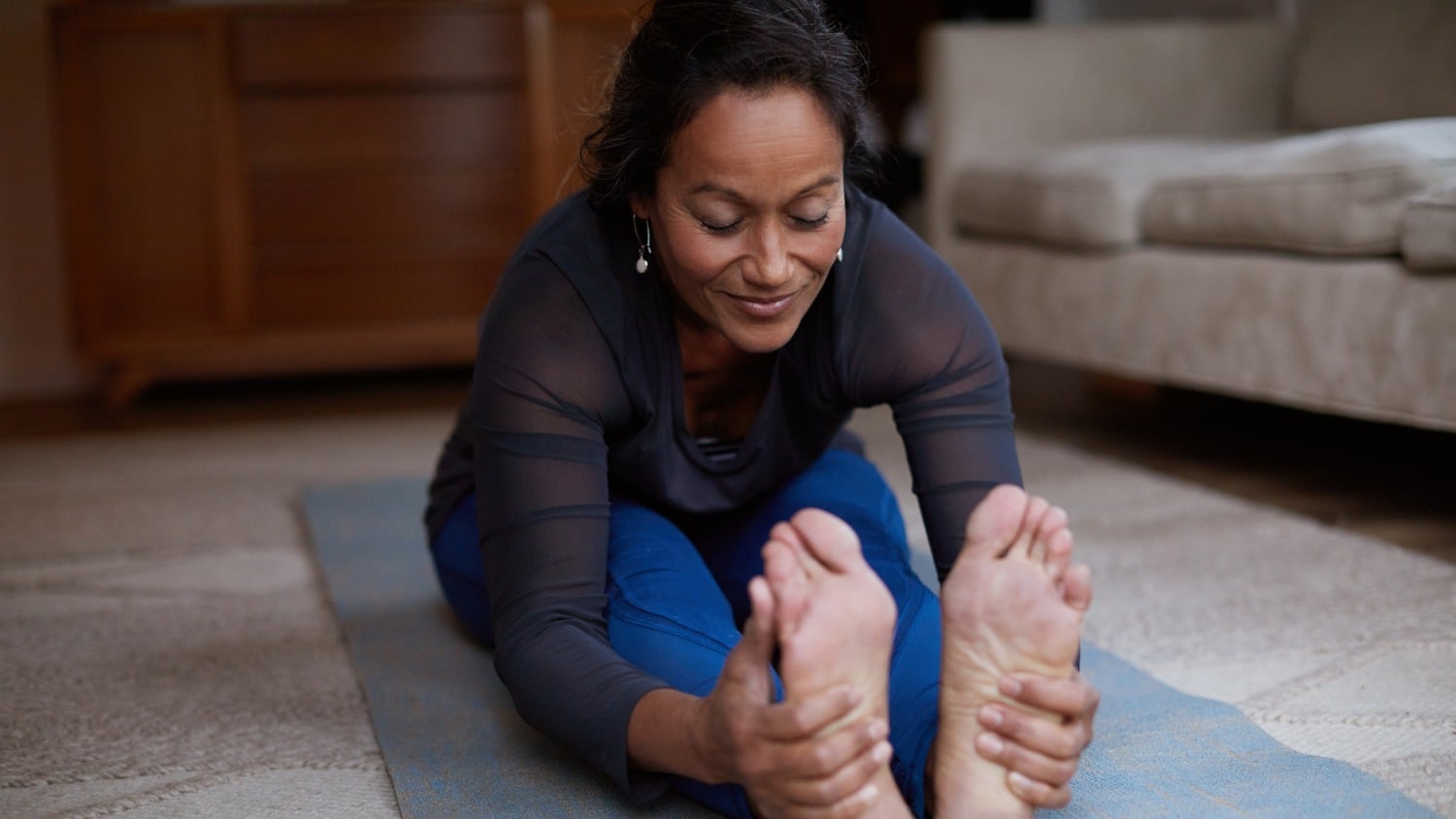
Simple practices like breathwork, gentle yoga movements, and awareness allow you to begin releasing the physical tension of what you’ve been holding. You don’t have to relive or analyze everything, you simply start by noticing where it lives in your body.
I wrote Yoga for Living with Loss, Navigating Our Losses Without Getting Lost to address how we meet transitions through breath, gentle movement, meditation, quiet rest, and more. By witnessing where the congestion of loss and transitions are revealed physically such as digestive issues, heartburn, laryngitis or headaches for example, we can become aware that we can ‘decongest’ with awareness, breath, and simple movements.
For example:
- A tight chest may soften with slow, steady breathing.
- Heavy shoulders may release through gentle movement.
- A constricted throat may ease when you give yourself space to express or simply feel.
These small shifts create space, not to erase the past, but to relate to it differently.
Why This Matters More After 60
At this stage of life, transitions often come closer together and carry deeper meaning. You’re not just navigating change, you’re integrating a lifetime of experiences.
The body keeps the score of all of it. When we don’t have a way to process these layers, they can accumulate as:
- Chronic tension
- Emotional overwhelm
- Fatigue or disconnection
- A feeling of being “stuck” in the past
But when we begin to gently move and support the body, something shifts. We feel more present, more grounded, and more able to meet what’s next.
You’re in Transition
It’s easy to believe that feeling stuck means something is wrong. But often, it simply means something in you hasn’t had the chance to move yet.
Transitions are not a sign that life is narrowing, they’re an invitation to relate to yourself in a new way.
You don’t need to rush. You don’t need to force clarity. You don’t need to do it perfectly. You only need a way to begin.
A Gentle Place to Start: Try this simple practice: Do this for just one minute.
- Place one hand on your chest and one on your belly.
- Take a slow breath in through your nose.
- Exhale gently through your mouth.
Notice what you feel, not to change it, but to acknowledge it. This is how release begins.
Life After 60 Isn’t About Becoming Someone New
It’s about learning how to hold everything you’ve lived, with a little more space, a little more softness, and a little more support. Because loss may be part of your story, but it doesn’t have to define how you live the next chapter.
Let’s find and revel in self-compassion, resilience, and embrace all that we have and will experience.
Join the Conversation:
Are you in transition? How has it affected your body and mind? Have you acknowledged this transition?


I moved to Georgia 20 years ago with my 5 year old son from the busy city of Detroit. He’s now 25 and I’m 66 years old, still working and about to transition back to Michigan. I’m having separation anxiety, I’ve never been away from my son. I am very excited about the move, my entire family is in Michigan and I miss them very much. My son is not moving with me. He is staying in Georgia. I know that this is good for both of us, especially my son. He has never been on his own and I feel that this is the only way that he will get out on his own. I feel that I’ve enabled him long enough. So, I’m real excited about moving back home but still feeling some type of way. I feel that I did what I set out to do, which was raise him away from Michigan and now I can return home. He has two previous daughters so he can’t leave his girls. I didn’t mention that that’s breaking my heart as well, leaving my granddaughters. I didn’t mention t feel guilty, just some type of way. Can’t put my fingers on it, or maybe I have. Separation anxiety. Any comments?
You are very brave, best wishes
HI, Thanks for sharing. Making big changes, such as yours, are always a challenge. I think you are doing the right thing for the right reasons but feelings of guilt along with excitement are part of the human experience. You are giving your son the greatest gift… self-sufficiency. And also, nothing is forever. As I often remember the Buddha quote… “Everything changes.” Please keep me posted. Wishing you all the best.