


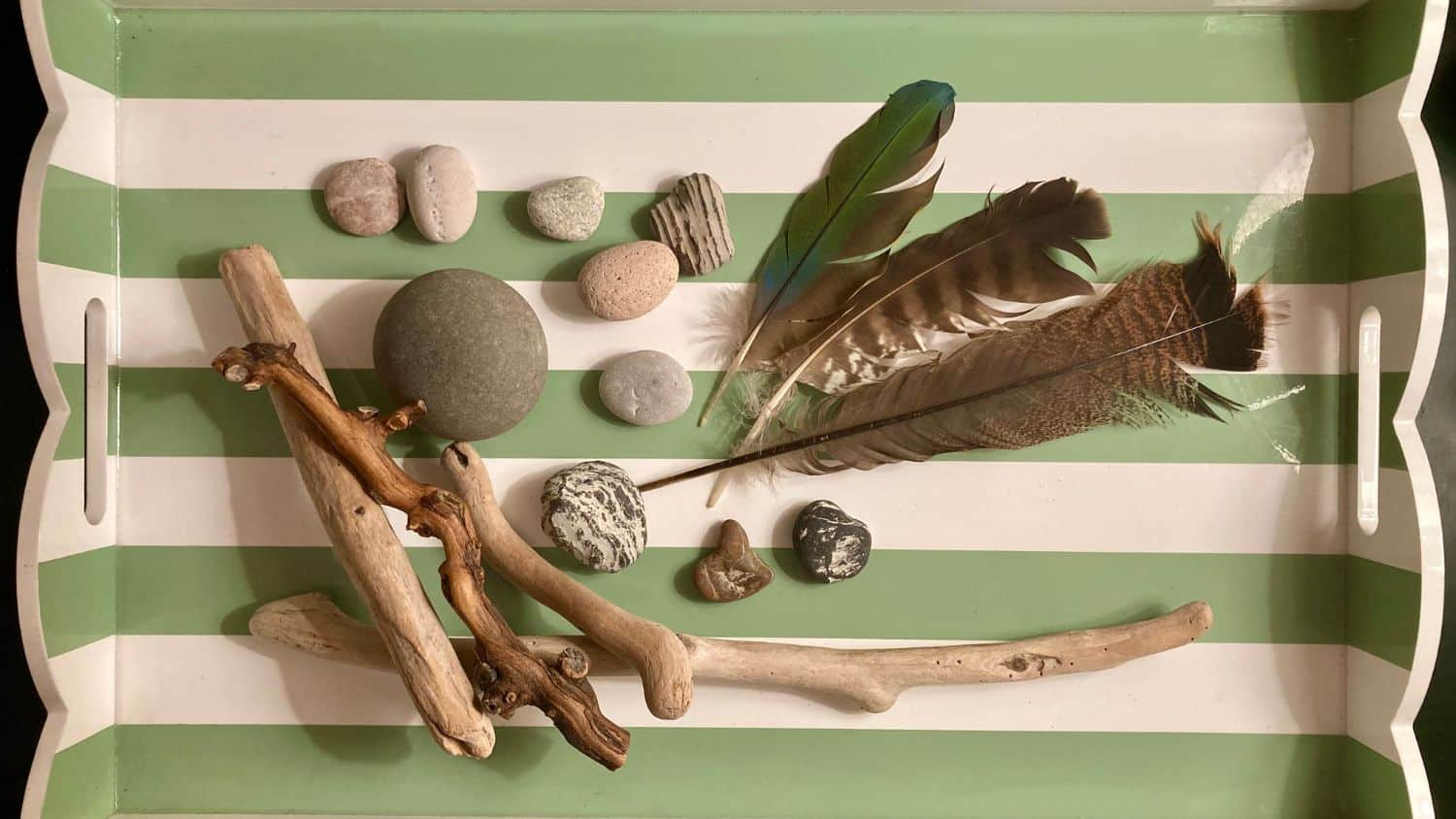
Driftwood, Feathers & Stones: Decorate Your Home with Nature @ NO COST
When you go for a walk in the woods or on a beach, do you collect feathers, stones, acorns, branches, shells, driftwood, sea glass or pine cones?
Nature & You: The Concept of Biophilia
A dry twig or branch with its beautiful asymmetrical structure tells a story of growth, of the weather, of heaven and earth. A single feather evokes the picture of a bird navigating on a mild breeze underneath a blue sky. A whitewashed stone on a beach talks about the eternal ebb and flow of life. We are part of this.

The biophilia hypothesis says that humans are born with an urge to connect with nature and lifelike processes. The term “Biophilia” was first used by Erich Fromm to describe a psychological orientation of being attracted to all that is alive and vital. In his book Biophilia (1984), Edward O. Wilson argues that “to explore and affiliate with life is a deep and complicated process in mental development. …. our spirit is woven from it, hope rises on its currents.” Long before Fromm and Wilson, Aristotle spoke of a concept that might be summarized as “love of life.”
So, you see, when decorating your home with objects of nature, you are expressing your connection with life.

The Japanese Philosophy Of WABI-SABI
A river or path shaped by nature will never be a straight line. There will always be curves. In traditional Japanese aesthetics, wabi-sabi is the appreciation of beauty that is “imperfect, impermanent, and incomplete.” Contemporary interior design relates to these principles by using organic materials, irregular forms, subtle textures, and visible signs of aging. The aim is to create a calm, authentic living environment.
By surrounding yourself with unique objects of nature you celebrate the flow and magic of life.
Here are 6 decorating ideas:
1. Twiggies in Vases

Arrange dry twigs in vases.If you feel like it, add fresh or artificial flowers, or feathers, to create interesting contrast. Do you have rosemary in your garden? Let the stems go dry and put them in a vase or bind them with a string – even after the tasty green leaves have gone, the energizing rosemary scent will stay on the stems for a long time. They make one-of-a-kind decorations for Thanksgiving or Easter.
2. Branch Out Your Deco

Hang a solid branch from the ceiling or (as seen in the picture) from above a door. I keep this branch up all year long and decorate it with the seasons (yes, in December, there’s sparkling X-mas deco on it). It moves slightly with the air.
Other ideas: Use a long solid branch as a curtain rod (for a light curtain). Or hang dried herbs on a branch in your kitchen. Or create a mobile, i.e. with postcards or feathers hung from the twigs.
3. Driftwood in a Basket

Nature objects are symbols of uniqueness. The imperfection contained in nature holds the beauty and fascination of life. No face, no body, no alive creature is ever perfectly symmetrical. In nature, no two objects ever look perfectly alike. Every animal, plant or tree, every stone, snowflake or cloud, every living creature is unique. Just like you. The plethora of driftwood and alike objects reminds you of your uniqueness on all levels.
4. Rock It. Tell Stone Stories!

When I look at my huge collection of stones, I instantly know where I found them. The lava stones are from a trip to Kauaii, the little light ones from an Italian beach, the perfectly round big grey darlings are from the west coast of Ireland. Appreciating their beauty, my mind gets to revisit all these fine places.
Become a stone-teller: Show off your treasures in baskets, trays or bowls.
5. Let Twiggy Hold Your Photographs

Leave the dry twig as it is or paint it in a colour of your choice. Gold is always a glamorous option. Attach a thin wire to fixate the twig with the photos (or postcards etc.) on the wall. Talking about thin: Model icon Twiggy will be turning 77 this year.
6. Fishing for Feathers

For this vertical wall decoration, attach feathers onto a double fishing thread. Put the feathers between the two threads. To keep the feathers in place (and the threads straight), attach a weight on the bottom end. When placed next to a window or door, a light breeze might make the feathers move a bit.
Best of all: You won’t spend any money. The magic of nature (and the gratitude for it) is for free. Just take a walk. Become a nature collector. Be like a child: Play with your pine cones, seashells, twigs, feathers and stones and dive into the fullness of life.
For more inspiration read my article „Six 1-Minute-Hacks To Redecorate At NO COST“ or see my book: 17 Steps to Being Home.
Let’s have a conversation:
How do you display your nature finds? What is a nature object that you particularly cherish? Is there a story connected to it? Share your creativity with this community. Your idea may be an inspiration for another fun project.


I love native mosses on my land and create zen terrariums using them. I try to include other natural finds – conks, lichen covered branches, rocks, etc.
I have a strong affinity for rocks, especially smooth ones, and quartz. At 78, I still have a sizeable rock that has accompanied me through many moves since I was a young teenager. Rocks, plants, and crafts made by hand in visited countries are what I surround myself with, as well as found rusty objects that have a place in my garden.
Ive always been fascinated by small bits of nature, especially when visiting a new area. A stone, shell, driftwood, starfish etc. I’ve a collection of birds nests that have fallen from trees at various addresses that Ive lived at. They are fascinating objects, one with made with mud, another with fluff & small soft objects, some tiny delicate ones. They are incredible works of art of nature. I used to display them on my back porch, but now ive found a place inside where they can brighten my days during the coming winter. Bringing beautiful bits of nature into our homes helps us relax, as we are part of that nature. So much nicer than plastics and mass made objects.
We only need to enter the home of someone who has decorated their home with timber, stone, indoor plants, etc and we will notice ourselves relaxing!
Thanks for the super ideas- I’ve been wondering what to do with all my feathers! I place some of my stones from the beach in my shower and enjoy them every day.
What a beautiful idea, Wendy, to turn your shower into a beach experience. Thank you for sharing and happy experimenting with your feathers!
Love this. I tend to gather things I find in nature, except when doing so harms nature, no collecting from national or state parks or tide pools. However, I have a small bird nest that fell from a tree, feathers collected in my own backyard and some rocks. I love the hanging branch ideas. Thank you.
Thank you, Liz. Glad that you found some inspiration – I very much appreciate your valuable input that collecting such objects should always be considerate of nature’s needs and conservational aspects. Warmly, Beate