


Is Your Walking Speed a Health Red Flag? How to Test and Improve It
Have you noticed that your walking speed has changed as you’ve gotten older? Maybe it was so gradual that you didn’t really notice it until it dawned on you that your younger friends and family members have started slowing their pace to match yours. Or maybe you’ve started outpacing many of your friends.
“So what?” you might ask. “Isn’t it normal to slow down as we age?”
Maybe a little: but a consistently slower pace is more telling than you might think. Your walking speed – what researchers call gait speed – has earned recognition as the “sixth vital sign” alongside blood pressure, heart rate, temperature, breathing rate, and oxygen saturation.
Why Your Walking Speed Is Your Health Crystal Ball
Think of your gait speed as your body’s report card. It’s a measure of your overall health and reflects how well your muscles, joints, heart, lungs, and brain are working together. When you start slowing down, it’s often your body’s way of telling you that something in this interconnected system needs attention. The faster and more efficiently you walk, the healthier you’re likely to be.
The research is compelling:
- A comprehensive analysis of over 34,000 older adults revealed that for every 0.1 meters per second decrease in walking speed, the risk of death increased by 12%.
- The slowest walkers faced more than double the mortality risk compared to their faster-paced peers.
- Maintaining a brisk walking pace of about 3 miles per hour has been linked to living 5–10 years longer, particularly beneficial for those who’ve been less active.
- Fast walkers may actually slow their biological aging by protecting telomeres – those protective “caps” on DNA that typically shorten as we age.
- Yet another study linked slower gait speed to a higher risk of cognitive decline and dementia.
Test Your Sixth Vital Sign
Ready to discover what your walking speed reveals about your health? Here’s how you can easily measure your gait speed:
What you’ll need: A stopwatch (or phone timer), measuring tape, and a flat surface.
The Test:
- Measure and mark a 10-foot (3-meter) distance on level ground.
- Start walking before you reach the starting line, then time yourself as you walk at your normal, comfortable pace through the measured distance.
- Calculate your speed by dividing the distance (in meters) by your time (in seconds).
Grab a Friend:
This test is even more fun (and can be a great motivator!) when you do it with a spouse, friend, or your walking group. It’s a simple, shared activity that can help you stay accountable and motivated to make improving your walking speed a priority.
Your Results:
- Excellent: 1.4+ m/s (3.1+ mph)
- Good: 1.0–1.4 m/s (2.2–3.1 mph)
- Concerning: 0.8–1.0 m/s (1.8–2.2 mph)
- Action needed: Below 0.8 m/s (1.8 mph)
Why We Naturally Slow Our Roll
Several factors can put the brakes on our walking speed as we age: gradual muscle loss (sarcopenia), joint stiffness, balance changes, and decreased flexibility.
The good news is that most of these factors can be improved with the right approach.
Your Speed-Boosting Action Plan
Strengthen Your Foundation
Focus on exercises that power your walking, such as squats, lunges, step-ups, and calf raises. You don’t have to go to a gym or buy special equipment either. Even bodyweight versions can make a significant difference.
Fuel Your Muscles
Remember that muscle requires protein to rebuild and grow. Make sure you’re getting enough high-quality protein in your diet to support the foundational strength needed for a brisker pace.
Add Interval Training to Your Walks
Alternate between your normal pace for two minutes and a brisker pace for 30 seconds. This trains your body to move efficiently at different speeds.
Stretch Daily
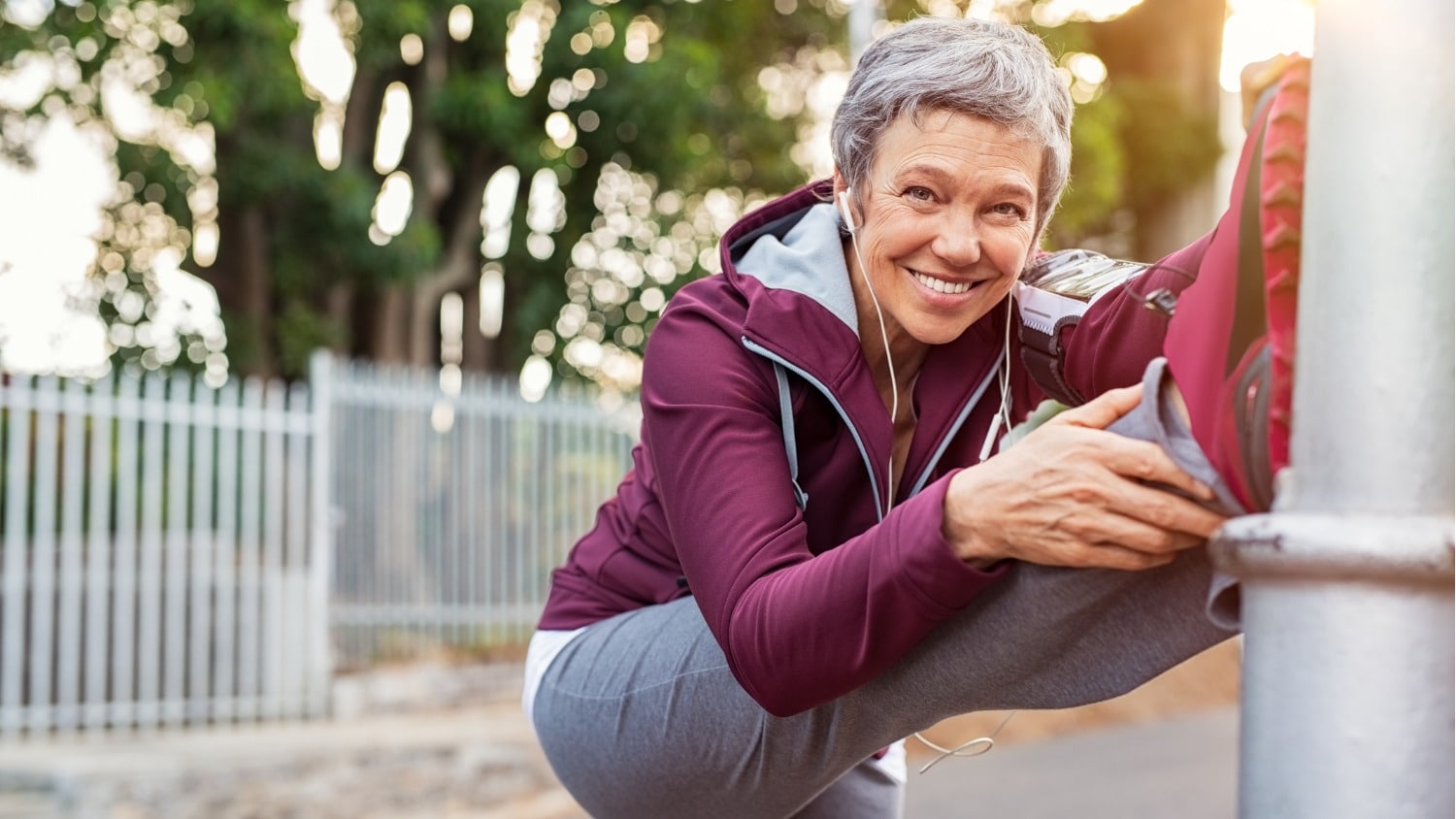
Pay special attention to your calves, hip flexors, and ankles – tight muscles in these areas can significantly slow your stride. I outline and describe several foot and ankle stretches and strengtheners in this blog post.
Work on Balance
Activities like yoga, tai chi, or simply practicing standing on one foot can improve the stability that supports more confident, faster walking. In this blog post I address balance and ways to improve it.
Check Your Footwear
The right pair of supportive shoes can make a world of difference. Proper footwear provides stability, absorbs shock, and can prevent the aches and pains that might cause you to slow down.
Perfect Your Posture
Walk tall with your core engaged, shoulders back, and eyes looking ahead rather than down at your feet.
Your Next Step Forward
Improving your gait speed improves your life by preserving your independence, supporting your cognitive health, and maintaining the energy to fully engage with and enjoy life for years to come. It’s an investment in the future you want to love.
Whether you’re currently a speed walker or more of a leisurely stroller, there’s always room for positive change.
Ready to take action? I’d love to hear about your gait speed test results and what strategies you use to pick up your pace.
For more evidence-based approaches to healthy aging, you can find additional resources and insights on my Wellgevity Warrior blog on Substack.
Let’s Keep the Conversation Going:
What was your baseline gait speed, and were you surprised by the results? Which of these speed-boosting strategies are you most excited to try first? Have you noticed changes in your walking speed, and what do you think contributed to those changes? What motivates you most: the health benefits of faster walking or the independence it can help preserve? Do you have a favorite walking route that could become your “speed training track”?
Share your insights and questions in the comments below—I love learning from this community’s collective wisdom!
Tags Fitness Over 60


What about people like me who’s legs are a bit shorter as im 5’2″ not 5’8″ etc? We dont quite do the distance maybe but we do as many steps.
Im 70 and 3 years ago did the intermittently walking a bit faster & then back, but did myself an injury (hip bursa etc) & then was in pain for so long and so couldn’t walk at all! These days after a hip replacement I just do my best to walk at the speed I feel comfortable with. As long as we are exercising i dont see the need to push ourselves.
You’re making the best choice for you, Tessa! You’re right to listen to your body and do what works and keeps you safe and injury free. Getting out and walking is the most important thing.