


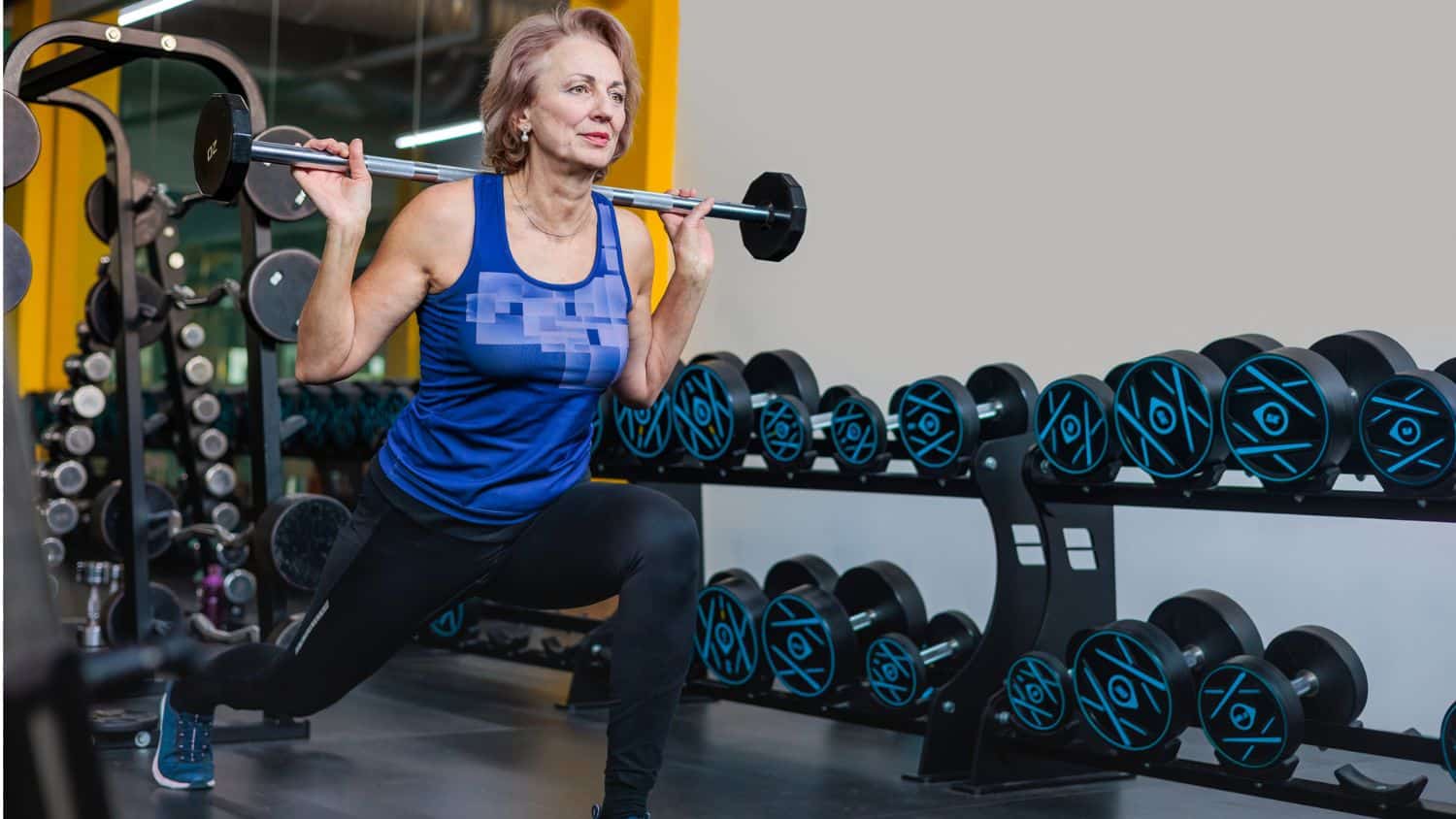
Train Smart: A Menopause Playbook
You might have heard it: train right. It’s everywhere: in the magazines, billboards, TV and social media. Many women are left with a somehow vague idea of what this might mean. Not many know exactly how, when and with which tools.
So many overwhelming and contradicting messages collide, and women are becoming increasingly frustrated and demotivated. I want to clear the fog and give you the step-by-step blueprint for structuring your training in midlife.
As you might know, estrogen fluctuation and decline are affecting muscle mass, cardiovascular and bone health, recovery, insulin resistance and body composition.
The good news: we can address this via structured strength and endurance training.
Let’s get into the details because this is where many women are being left uninformed and confused. The 3 pillars are: Strength Training, Endurance Training and Impact Training.
1. Strength Training
Strength training is non-negotiable to protect and build muscle in midlife.
The protocol: 3 strength training sessions per week based on the principle of progressive overload (more reps/sets or heavier load or change of tempo while moving the load). I recommend 2 upper body and one lower body strength training session split in Chest/Triceps/ Shoulders, Back/Biceps and Legs. Core is always part of each session. Strength Training does not mean you need to belong to a gym. This can be done at home with dumbbells and resistance bands.
For muscle growth, also called hypertrophy training, choose a weight that is heavy enough for you to move it about 8-12 times. The 10th repetition should feel very challenging. If this felt too easy, increase the weight.
This is the most straight forward training principle. Other protocols are defined in less repetitions and more weight or more repetitions with less weight. These are muscle strength and muscle endurance protocols. Both are useful but if you are just starting out, use the hypertrophy training protocol.
My most recommended lifts: hinge pattern (deadlift/kettlebell swing), squats, rows, presses.
Deadlift: start & finish
Back squat: start & finish
Single-arm dumbbell row: start & finish
Dumbbell shoulder press: start & finish
TRX chest press: start & finish
2. Endurance Training
This is where I see the biggest confusion on how to structure cardiovascular exercises. The biggest problem I see is that many women are advised to skip cardio, only do sprint intervals or incline walking. Unfortunately, it is more complex and needs to be structured to address cortisol and cardiovascular capacity.
Cardiovascular Disease kills more women than all cancers combined. Endurance training is just as imperative as strength training if you are a woman in midlife. VO2 max besides grip strength is your number one indicator of longevity and can be addressed via interval training (HIIT/SIT). Without a foundation of endurance your system is not able to handle interval training. This is where Zone 2 training is important to build your foundation.
The protocol: 3 endurance training sessions per week with two Zone 2 (conversational pace) and 1 interval (max 2) training session. Zone 2 Training needs to sit around 35-45 minutes. Interval Training consists of the same duration including warm up and cool down.
3. Impact Training
Progressive Strength training has been shown to improve bone density. Impact training does something similar: it sends a signal to your bones to increase bone density. In short: impact training builds bone. This is where the weighted vest debacle comes into the spotlight. Weighted vests alone have not shown to increase bone density as the old study added impact training such as jumping. Weighted vests alone have not been shown to achieve an increase in BMD (bone mineral density).
Impact training, however, sends a signal to your bones to adapt, and it can be achieved initially via brisk walking, running, heel drops and jumping.
The protocol: 3 sessions of impact training which can be included after or during your strength or endurance training session.
If you are over 60 or new to impact, start slowly: begin with heel drops and brisk walking, and add jumping only once those feel easy.
Heel drops: rise onto your toes, then drop onto your heels
I hope that this overview of the 3 pillars was helpful and that you are leaving with a clearer mind and less confusion.
Images credit: Joshua Bobrove.
References:
American Heart Association. “Cardiovascular Disease: Women’s No. 1 Health Threat.” Go Red for Women. Accessed September 17, 2026.
Beavers, Kristen M., S. Delanie Lynch, Jason Fanning, Marjorie Howard, Erica Lawrence, Leon Lenchik, Sue A. Shapses, et al. “Weighted Vest Use or Resistance Exercise to Offset Weight Loss–Associated Bone Loss in Older Adults: A Randomized Clinical Trial.” JAMA Network Open 8, no. 6 (2025): e2516772. https://doi.org/10.1001/jamanetworkopen.2025.167
Kim, Youngwon, Tom White, Katrien Wijndaele, Kate Westgate, Stephen J. Sharp, Jørn W. Helge, Nick J. Wareham, and Søren Brage. “The Combination of Cardiorespiratory Fitness and Muscle Strength, and Mortality Risk.” European Journal of Epidemiology (2018).
Kistler-Fischbacher, M., Benjamin K. Weeks, and Belinda R. Beck. “The Effect of Exercise Intensity on Bone in Postmenopausal Women (Part 2): A Meta-Analysis.” Bone 143 (2021): 115697.
Mandsager, Kyle, Serge Harb, Paul Cremer, Dermot Phelan, Steven E. Nissen, and Wael Jaber. “Association of Cardiorespiratory Fitness with Long-Term Mortality among Adults Undergoing Exercise Treadmill Testing.” JAMA Network Open 1, no. 6 (2018): e183605. .
Snow, Christine M., Janet M. Shaw, Kerri M. Winters, and Kara A. Witzke. “Long-Term Exercise Using Weighted Vests Prevents Hip Bone Loss in Postmenopausal Women.” The Journals of Gerontology: Series A 55, no. 9 (2000): M489–M491.
Watson, Steven L., Benjamin K. Weeks, Lisa J. Weis, Amy T. Harding, Sean A. Horan, and Belinda R. Beck. “High-Intensity Resistance and Impact Training Improves Bone Mineral Density and Physical Function in Postmenopausal Women with Osteopenia and Osteoporosis: The LIFTMOR Randomized Controlled Trial.” Journal of Bone and Mineral Research 33, no. 2 (2018): 211–220.
Wright, Vonda J., et al. “The Musculoskeletal Syndrome of Menopause.” Climacteric (2024).
Let’s Have a Conversation:
Where are you on the exercise spectrum? How many times have you started over because you didn’t know exactly what to do to build strength? How do you feel after an exercise session?
Tags Fitness Over 60


